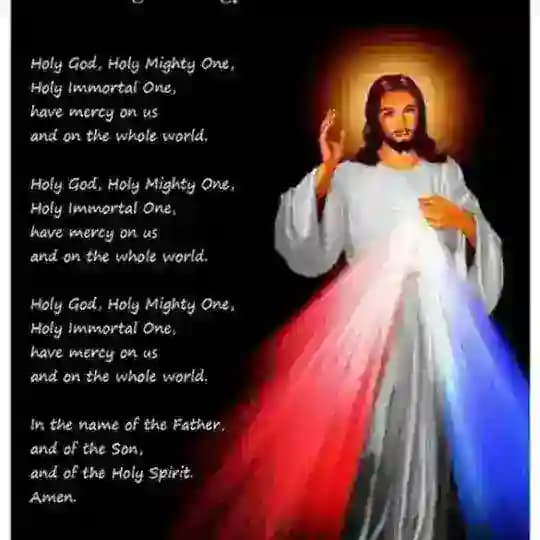
The mission that the Lord entrusted to St. Faustina, however, cost her very much. She suffered greatly in fulfilling her mission as the Apostle of Mercy. In her novitiate, she was visited by painful mystical experiences and underwent a dark night of the soul. She also was very weak physically her whole life, and was often plagued by severe illness, which hospitalized her for months at a time. She suffered many spiritual and moral suffering related to the mission to which she had been entrusted. Many people, including her sisters, believed she was delusional and crazy because of her deep communion with God and her desire to have the image painted and propagated. As well, the Lord allowed her sisters to often misinterpret her intentions and true state of health; this caused her deep sufferings, for she was often look upon as weak and one who was feigning illness. For years, she did not have a confessor or spiritual director that understood the workings in her soul, and this left her in an almost constant state of confusion. The Lord asked her to found a new congregation (which never happened in her lifetime). Because of all these requests that Jesus placed on her (the image, the feast day, and the congregation), she was often doubted by her superiors, priests, and bishops. She was a “sign of contradiction” just like her beloved Spouse. She became a victim soul, suffering for the salvation of sinners; this entailed diverse sufferings which included the “passive night” of the spirit and hidden stigmata. Often she would take on spiritual battles and punishments in order to save sinners and prevent people from committing mortal sins. She also prayed and suffered greatly for the souls in purgatory. Eventually, she contracted tuberculosis, and finally succumbed to the disease, physically ravaged by its effects on October 5, 1938 at the age of 33 years. She died physically exhausted, but united mystically with God, totally mature in spirit, and in the odor of sanctity. She had lived thirteen of her 33 years in the convent. Her funeral took place two days later, on the Feast Day of Our Lady of the Rosary, which in that year was the First Friday of the Month.
HER MISSION
The mission of Saint Faustina consisted of three tasks:
First, proclaiming and bringing the world closer to the truth of the merciful love of God for every human being, as revealed in the Scared Scriptures.
Second, imploring God’s mercy for the entire world, and particularly for sinners, through the practice of the new forms of devotion to The Divine Mercy asked for by the Lord Jesus.
Third, initiating the apostolic movement of Divine Mercy whose devotees and apostles shall bring about a religious renewal among the faithful in the spirit of this devotion, namely, acquiring an attitude of childlike trust in God and actively living the commandment of love and mercy toward one’s neighbor.
In obedience to her spiritual director, she wrote a diary of about 600 pages in which she gives account of the revelations she received on the Mercy of God. The devotions and methods proposed are as follows:
1. Veneration of the Image of the Divine Mercy
The pattern for the image was revealed to St. Faustina on February 22, 1931. From her Diary: “In the evening, when I was in my cell, I saw the Lord Jesus clothed in a white garment. One hand [was] raised in the gesture of blessing, the other was touching the garment at the breast. From beneath the garment, slightly drawn aside at the breast, there were emanating two large rays, one red, the other pale... After a while, Jesus said to me, Paint an image according to the pattern you see, with the signature: Jesus, I trust in You (Diary 47). I want this image…to be solemnly blessed on the first Sunday after Easter; that Sunday is to be the feast of my Mercy (Diary 49).” He promised to her, “By means of this Image I shall be granting many graces to souls” (Diary 570).